
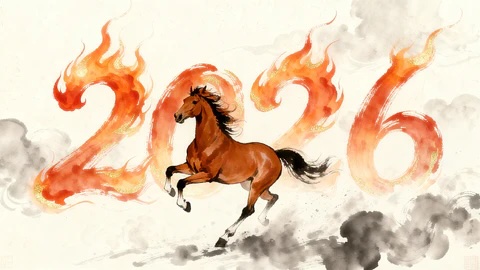
The Tibetan New Year, Losar, on February 18 2026, inaugurates the Fire Horse year — a rare combination that occurs only once every 60 years. In Tibetan calendrical naming, this year is known as the Male Fire Horse in the 60-year Rabjung cycle.
🌀 Core Cultural Themes
Traditionally, the Horse in Tibetan and Himalayan cultural astrology symbolizes movement, courage, freedom, and momentum — often associated with the lungta (wind-horse) that carries blessings and fortunes across the winds of life.
The Fire element adds an intensification to this symbolism — representing illumination, purification, warmth, and transformative heat. When these two combine in the Fire Horse year, it is understood culturally as a period of:
• Energetic momentum and swift change — life circumstances and wider trends may feel like they’re moving quickly or decisively.
• Karmic acceleration — the sense that spiritual and worldly efforts can yield multiplied results compared to other years.
• Purification and renewal — the fire metaphorically “burns away” stagnation and invites clarity and release of old patterns.
Among some Himalayan folk beliefs (drawing from both Tibetan and adjacent Bon contexts), this year’s energy resembles the inner fire of transformation — a time when both personal and communal life can undergo notable shifts, especially when bold intention and clarity are aligned.
🕊️ Spiritual & Pilgrimage Significance
In popular Tibetan cultural belief, Fire Horse years are sometimes regarded as especially fruitful for:
- Pilgrimage and koras (for example around sacred sites like Mount Kailash or a stupa), where the merit gained is traditionally considered to be much greater than usual.
- Prayer flags and blessing activities, emphasizing rising lungta and sending prayers outward with increased force.
- Beginning new spiritual practices or major vows, as the energy of change supports forward movement.
These interpretations don’t come from formal Vajrayana practice texts but folk tradition and cultural astrology, and are best understood as symbolic language describing the quality of the year’s collective “wind” rather than literal destiny-telling.
🌍 A Balanced Cultural View
While many Asian-zodiac-style interpretations (which have also woven into Tibetan usage) may focus on luck, career, or love-life predictions, the Tibetan cultural lens often frames the Fire Horse year more holistically:
- It emphasizes momentum and opportunity, but also the need for skillful direction of that energy.
- It suggests auspiciousness for spiritual activity and pilgrimage, especially when approached with devotion and discipline.
- It resonates with the symbolism of windhorse, which carries prayers and aspirations — reminding people to release worldly “weights” and raise beneficial intention.
Losar Through the Lens of Mandala
Now here is where I want to bring in our Vajrayana lens. Because the mandala is always our translator.It takes what could feel like fortune-telling or external prediction and turns it into inner practice language—something we can actually ride. So the Fire Horse becomes not, “What will happen to us?”
But instead: What kind of energy is arising in the collective wind this year?And then: How do we meet it with wisdom? Which Buddha family is the remedy, the balance, the seat?
Fire Horse Through the Mandala Lens
So if we translate this Fire Horse year into mandala language, we might say: Horse energy is lungta—speed, movement, courage, outward momentum. Fire element is intensity, transformation, purification, heat, passion. And as we know, every energy has a shadow expression. The shadow expression of this combination might be impulsiveness, conflict, reactivity, ego-speed.
And so the mandala medicine—the balancing wisdom—becomes: Ratnasambhava on the horse throne.
Ratnasambhava: the wisdom of equanimity and richness.
The antidote to grasping, to scarcity mind, to instability.
The grounded dignity that knows how to hold strong energy without being thrown off center.
In other words:
Let the energy move, but don’t lose the center.
This year may move quickly.
The winds may be strong.
The question is not whether the horse runs — but whether we ride with awareness.
And if we can ride with awareness, then the Fire Horse year becomes something beautiful:
a year of courageous intention,
a year of practice,
a year of purification,
a year of momentum aligned with wisdom.
Please leave a comment or intention…..for this New Year below.
Wow! Has this really been up since 2022 and before and I’ve missed it until now? Such a perfect snapshot of radiance. Thank you!! As you’ve described it Lopõn Ellen, I can already feel the turning, the sacred presence of the year of the fire horse. There is a stillness even as the ground begins to tremble. May our new year bring deep determination, resiliance and transformative healing in all aspects of our lives. May all beings truly benefit. A la la ho!
Thank you, Denise, for your beautiful intention. May it be illuminated and multiplied! Love, Lopön
Thank you for this share Lopon Ellen through the Key West Sangha newsletter. I agree that the more intentional and expansive reading for the year is for wisdom purposes. Another aspect of the forecast I have heard from Chinese astrology practitioners is also about the balancing aspect for the fiery winds, which is the metaphor of water representing, wisdom, stillness, rest, inner strength. May we continue to be discerning of our inner selves in service to all. Li-Lan Hui-Chun
Thank you, Li-Lan, for sharing this beautiful perspective. I agree with the representation of the water element. As I prepare to teach the Yab Yum retreat next month, I have been looking at the feminine deity energy of “prajna,” which may symbolize the water element, and the masculine deity energy of “upaya,” which may symbolize both fire and air. Your thought here suggests their union in the Male Fire Horse Year.