
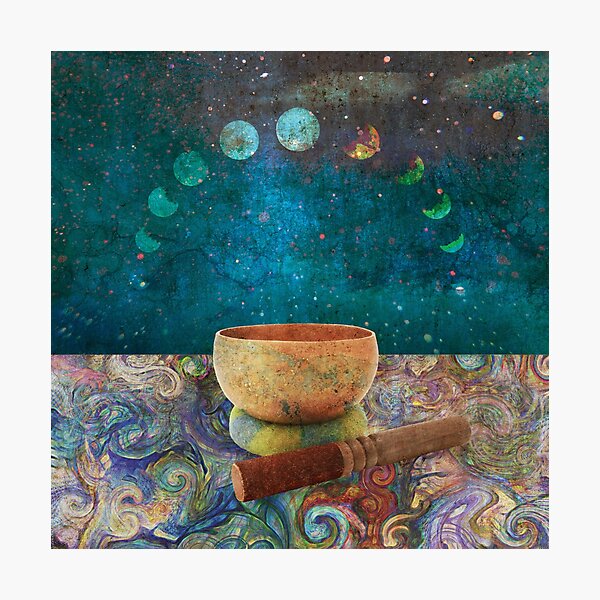
A Reflection on the Pause in Vajrayana Practice
By Lopön Ellen Booth Church
Perhaps we all could use a “moment between” right now.
A moment between grief and anger.
A moment between worry and action.
In Vajrayana practice, these moments appear again and again—small openings where the momentum of thinking and doing softens, and awareness can simply rest.
Yet even within practice it is easy to miss them.
One line of a mantra finishes and the eyes move forward.
The mind leans toward the next phrase.
The page turns.
Something subtle, yet essential, can slip past unnoticed.
It is like sounding a singing bowl and missing the moment when its tone dissolves into space.
The bowl has not finished speaking when the mallet stops moving. Likewise, the mantra has not finished practicing us when the syllables end. The pause is where its meaning unfolds—not conceptually, but somatically and energetically.
As you read this, I invite you to pause for just a few breaths.
Not to reflect or analyze—simply to stop.
Notice the space between this sentence and the next.
This subtly demonstrates exactly what the article is about, without explaining it yet.
In Vajrayana practice, much is said about mantra, visualization, and precise ritual form. These are powerful methods, refined over centuries. Yet there is a moment that often goes unnoticed—quietly skipped over, almost unconsciously. It is the moment after the mantra is recited, after the visualization is clearly formed, after the lines are recited, before we move on to the next line of the practice.
This is the pause.
The pause is not a gap, an absence, or a mistake in the rhythm of practice. It is not “dead time” between one thing and the next. The pause is the resonance of the mantra or the spoken lines—the moment when vibration has been released, and awareness is free to recognize itself.
If we rush past this moment, we miss something essential. The practice has been spoken, but it has not yet been fully experienced.
In Vajrayana, the pause is not peripheral.
The pause is an essential part of the practice.
Where Form Empties Itself
Every mantra arises, sounds, and dissolves. Every visualization appears, stabilizes, and releases. The pause is the moment when form naturally empties itself back into space. Nothing needs to be added. Nothing needs to be improved.
It is here that awareness functions like a mirror—clear, open, and naturally reflective. The sound has ceased, yet something remains. The image relaxes, yet presence is vivid. This is not blankness. It is luminous knowing.
Without the pause, we stay in doing.
With the pause, we touch being.
Embodiment: Letting the Practice Land
When there is no pause, the body never quite catches up. The mouth recites, the mind visualizes, but the body remains slightly behind—uninhabited, unlistened to.
The pause allows the practice to resonate.
It gives the body time to feel:
- the vibration of mantra echoing in the chest or belly
- the subtle shift in breath
- the posture of the deity settling naturally rather than being held
In the pause, the practice stops being something we perform and begins to live through us. We are no longer doing the practice. We are being the practice.
Noticing the space between the parts of a sadhana is about creating the conditions where recognition can occur. In those moments between, we are noticing what is already present, trusting the space, letting experience lead, and letting language follow.
Wisdom’s Play
In Tibetan, there is a word rolpar, often translated as “play.”
But this is not play in the ordinary sense. It is wisdom at ease with itself—awareness expressing without effort or strain.
The pause invites this quality. When we do not rush forward, when we allow sound and form to dissolve naturally, practice begins to move on its own. There is less effort, less management, and more confidence in what is already here.
In this way, the pause is not passive. It is wisdom’s play.
In Vajrayana, when practice becomes too tight, too goal-oriented, too linear, we lose contact with this playful intelligence. The pause restores it. It lets practice laugh a little, breathe, shimmer—like a dakini appearing and dissolving in the sky.
The Pause as Devotion
And you can also look at the devotional quality of pausing.
To pause is to trust.
To pause is to not fill space with effort.
To pause is to allow blessing to descend rather than be manufactured.
In Vajrayana, devotion is not an emotional display; it is receptivity. The pause is an offering of space—an act of confidence that awareness knows what to do without our constant management.
In the pause, we allow the lineage to respond.
We allow the mantra to complete itself.
We allow wisdom to arise on its own terms.
Training in Non-Grasping
The urge to move on can be seen as a subtle form of grasping. It is the habit of forward momentum, even in spiritual practice. The pause gently interrupts this habit. It trains us in non-fixation without struggle.
Nothing dramatic is required. Sometimes a single breath is enough.
Pause.
Feel.
Allow.
The Moment Between
The pause is the moment between sound and silence, form and space, invocation and recognition. It is small, easily overlooked, and utterly transformative.
If we allow it, the pause practices us.